Effective management of a Statistical Analysis Plan (SAP) lifecycle is a systematic process governing the document from initial draft to final archival. This framework is foundational for ensuring regulatory compliance and the scientific validity of a clinical trial. A well-managed lifecycle creates a transparent, controlled, and prospectively defined plan for the analysis of trial data.
The Foundation of Compliant Clinical Analysis
Statistical analysis plan lifecycle management is a critical operational discipline, not merely an administrative task. It establishes the defensibility of a clinical study by providing a clear, auditable trail of statistical intentions for regulatory bodies such as the FDA and EMA. This is essential for demonstrating the prevention of analysis bias and ensuring the reproducibility of study results.
This structured process transforms the SAP from a static document into a controlled asset governed by formal procedures. Each phase builds logically upon the previous one, culminating in a robust record capable of withstanding the scrutiny of a regulatory submission.
Core Phases of the SAP Lifecycle
The lifecycle of an SAP comprises several distinct, interconnected stages. These phases ensure the statistical strategy is planned, executed, and archived according to established best practices and regulatory expectations.
The process flow below provides a high-level overview of the entire lifecycle, from planning and drafting through execution and archival.
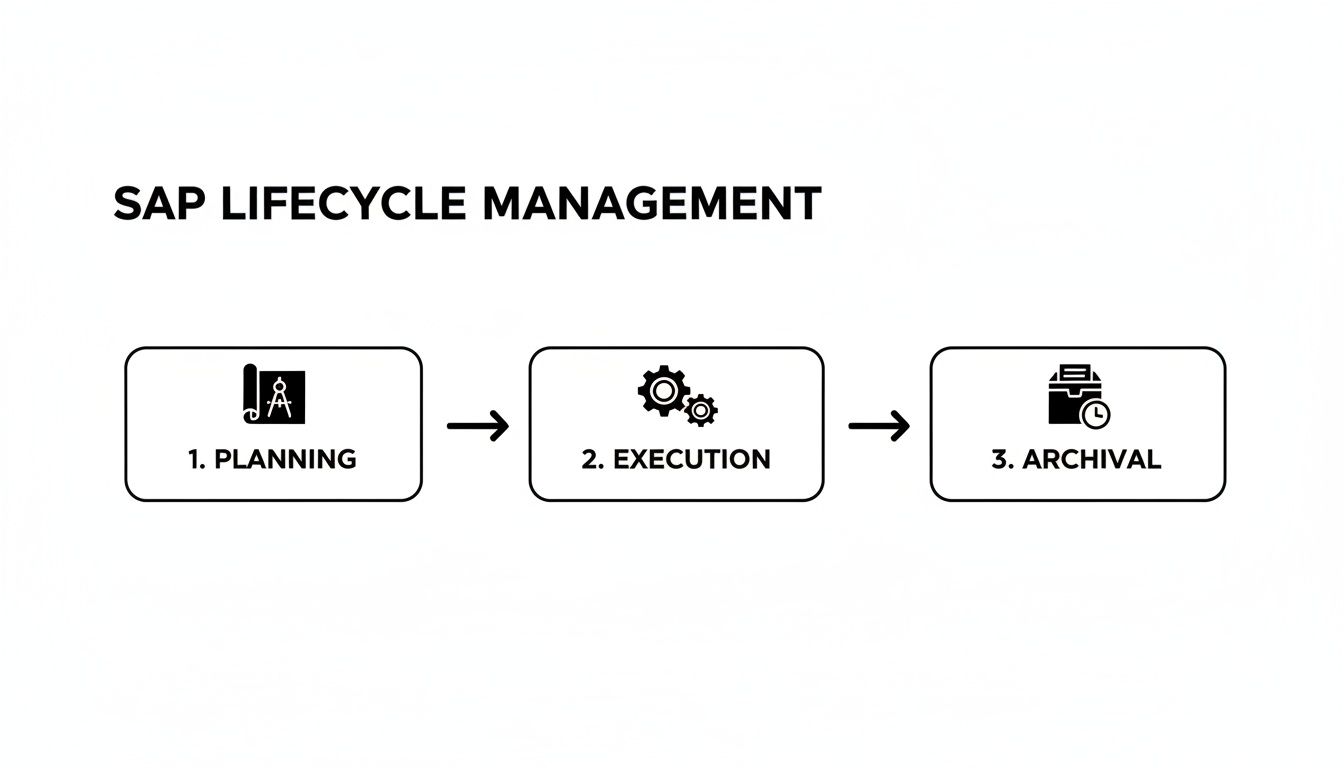
This visual represents the continuous, checkpoint-driven nature of the process. Each step serves to maintain quality and compliance, ensuring the SAP remains a reliable blueprint for the subsequent clinical study report (CSR).
The following table breaks down the core phases, their objectives, and their key outputs.
Core Phases of SAP Lifecycle Management
| Lifecycle Phase | Primary Objective | Key Output |
|---|---|---|
| Planning & Drafting | To define the statistical methodology based on the study protocol and objectives. | A complete draft SAP ready for internal and external review. |
| Review & Approval | To achieve consensus on the analysis plan among all key stakeholders (biostatisticians, clinicians, sponsors). | A finalized, version-controlled, and formally signed-off SAP. |
| Implementation | To execute the statistical analyses as pre-specified in the approved SAP. | Analysis datasets (e.g., ADaM), tables, listings, and figures (TLFs). |
| Amendments | To formally document and justify any necessary deviations or changes to the plan post-approval. | A versioned SAP amendment with a clear rationale and audit trail. |
| Archival | To securely store the final SAP and all related documentation for long-term retention. | A complete, auditable package of all SAP versions and records. |
Each phase is a critical component in maintaining the integrity of the analysis from initiation to completion.
A primary goal of managing the SAP lifecycle is to protect the scientific integrity of the trial. A prospectively defined analysis plan, finalized before unblinding of study data, is a principal defense against the biased or selective reporting of study outcomes.
Regulatory Context and Operational Best Practices
The requirement for a structured approach to SAP management is formalized by global regulatory authorities. The SAP is a mandatory document that serves as a critical supplement to the clinical trial protocol, detailing all planned analyses.
Industry best practices, aligned with regulatory guidance, recommend that the initial SAP be finalized before the first patient's first visit (FPFV) for open-label trials. For blinded studies, it is imperative that the SAP is finalized before database lock (DBL). This regulatory framework establishes the SAP's role as a cornerstone of clinical trial operations. For additional context, you can review regulatory expectations for SAPs and their lifecycle.
Translating the Protocol into a Draft SAP
Following the final approval of the clinical trial protocol, the detailed analytical planning commences. This involves translating the study's objectives into a comprehensive set of instructions. The initial draft of the Statistical Analysis Plan (SAP) serves as the operational blueprint for the data analysis and reporting strategy. The quality of this initial draft is crucial for the subsequent phases of the statistical analysis plan lifecycle management process.
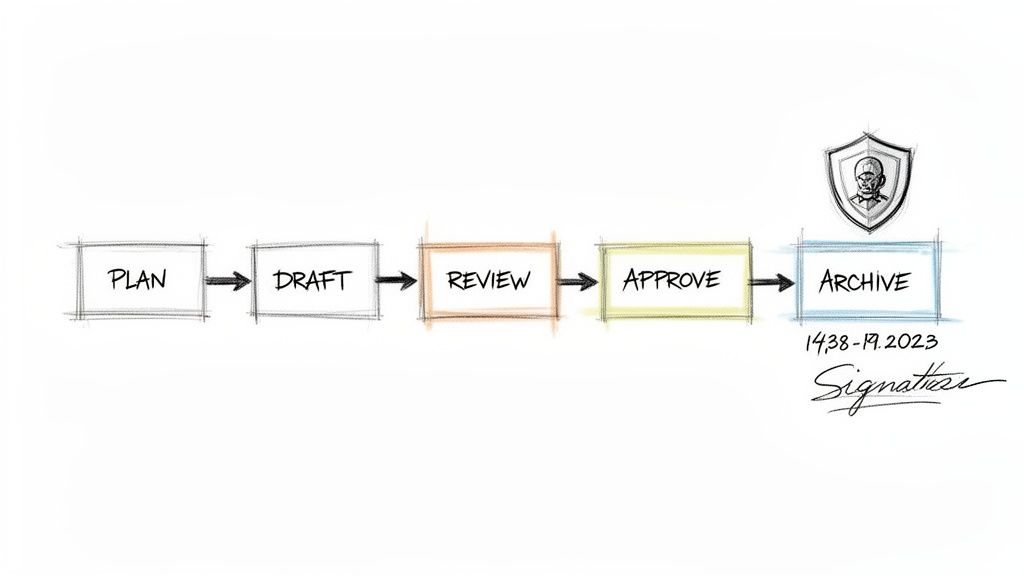
Before SAP authoring begins, several key source documents must be finalized and available. These are essential inputs for creating a coherent and complete plan.
- Final Approved Protocol: The SAP must align directly with the study objectives, endpoints, and high-level statistical approaches defined in the protocol.
- Case Report Form (CRF) Specifications: The annotated CRF (or eCRF) provides the specific variable names and data structures required to define analysis datasets.
- Data Dictionaries: These documents define each variable, its format, and permitted values, which is fundamental for specifying data handling and transformation rules.
Assembling the Cross-Functional Team
Drafting an SAP is a collaborative, cross-functional effort. To create a plan that is statistically sound, clinically relevant, and operationally executable, a team with diverse expertise is required from the outset.
The lead biostatistician typically drives the authoring process, translating the scientific objectives of the protocol into specific statistical methods.
This role is supported by other functional areas. Clinical scientists and medical monitors provide the clinical context to ensure the analysis addresses relevant scientific questions. Statistical programmers offer an operational perspective, confirming that the planned analyses can be implemented with the collected data.
A common operational oversight is drafting an SAP without input from statistical programmers. Involving them early in the process helps avoid specifying analyses that are overly complex or infeasible to implement, thereby preventing significant delays and late-stage amendments.
From Protocol Objectives to Specific Instructions
A primary function of SAP development is to translate the high-level language of the protocol into unambiguous, detailed instructions. The objective is to eliminate interpretive ambiguity after database lock and unblinding.
For example, stating the use of an "Intent-to-Treat (ITT) population" is insufficient. A regulatory-compliant SAP must define it with precision, such as, "All randomized subjects who have received at least one dose of the investigational product."
Similarly, the primary endpoint analysis requires explicit detail. Instead of "ANCOVA will be used," the SAP should specify:
- The model: Analysis of Covariance (ANCOVA).
- The dependent variable: Change from baseline in Y score at Week 12.
- All factors and covariates: Treatment group, baseline Y score, and randomization strata.
Specificity is essential for mitigating ambiguity and potential regulatory challenges.
Utilizing a Standardized Template
Initiating the drafting process with a well-structured, compliant template is an effective operational practice. A robust template ensures all required sections, guided by principles in ICH E9 (Statistical Principles for Clinical Trials), are included from the start.
Using a pre-defined structure promotes consistency across studies within a program and helps ensure critical details, such as procedures for handling missing data or defining safety analysis populations, are not overlooked. This facilitates more efficient preparation of regulatory submissions.
To provide teams with a reliable foundation, a comprehensive statistical analysis plan template aligned with industry best practices can be utilized. This approach supports the creation of an inspection-ready document from the initial draft, which is key to minimizing future queries.
Finalizing the Plan: The Review and Approval Process
Once a complete draft of the Statistical Analysis Plan (SAP) is available, it enters the review and approval phase. This stage transforms the technical document into a cross-functional agreement that guides the study analysis and is prepared for regulatory inspection.
The objective of this phase is to orchestrate a systematic review that incorporates feedback from all relevant functional areas. This ensures the SAP is not only statistically sound but also operationally viable and aligned with overall study objectives.
The Cross-Functional Review Cycle
The SAP review is an iterative process that relies on input from stakeholders with different areas of expertise.
- Biostatistics: The lead statistician ensures that any proposed changes are statistically valid and do not compromise the scientific integrity of the plan.
- Clinical Operations: This team provides input on whether the defined analysis populations and variables are deliverable based on data collection procedures.
- Regulatory Affairs: This function reviews the SAP for alignment with commitments made to health authorities like the FDA or EMA.
- Data Management: This group confirms that all variables and datasets specified in the SAP can be accurately derived from the clinical database.
- Medical Writing: This team ensures consistency in terminology and definitions between the SAP, the protocol, and the future Clinical Study Report (CSR).
Conflicting comments may arise during this process. For example, the clinical team might request a new subgroup analysis that the regulatory team identifies as a potential post-hoc analysis, which could be viewed unfavorably by authorities.
A formal, documented resolution process is essential for managing conflicting feedback. The lead biostatistician typically facilitates this process, evaluating each comment and documenting the rationale for its acceptance, modification, or rejection. This creates a clear, auditable trail suitable for inspection.
Formal Approval and Document Finalization
After all comments have been addressed and resolved, the SAP is ready for formal approval. This step finalizes the plan, establishing it as the authoritative guide for all subsequent analyses.
The approval process typically involves collecting electronic signatures from a pre-defined list of approvers within a validated system. Each signature serves as an attestation from the stakeholder that the SAP is final and ready for implementation. The standardization of such processes has significantly improved data integrity in clinical trials by mitigating the risk of post-hoc analyses that could create the perception of selective reporting. For more information on this topic, you can discover more insights about developing a robust SAP for clinical trials.
For a more detailed examination of this stage, our guide on document review and approval workflows in clinical trials provides additional information.
From Approval to Implementation
A final, approved SAP serves as the primary instruction document for the statistical programming team. A clear, well-vetted plan is the most effective tool for preventing errors and delays during the analysis phase.
This approved document is the source for creating critical deliverables:
- Analysis Datasets: Programmers use the SAP as a blueprint for generating Analysis Data Model (ADaM) datasets.
- Tables, Listings, and Figures (TLFs): The plan dictates the exact layout and content for all tables, listings, and figures intended for the CSR.
Without this clarity, programmers may be forced to make assumptions, leading to inconsistencies and deviations. A well-managed review and approval workflow ensures the SAP is a precise blueprint, facilitating a smooth transition from planning to execution and supporting a defensible regulatory submission.
Managing SAP Amendments and Version Control
Clinical trials rarely proceed without modifications. New regulatory guidance, recommendations from a Data Monitoring Committee, or unexpected events during trial conduct may necessitate changes to the original plan. A key component of statistical analysis plan lifecycle management is a disciplined, transparent, and auditable process for handling such modifications.
It is important to distinguish between minor clarifications and significant modifications that could alter the interpretation of study outcomes.
Distinguishing Clarifications from Formal Amendments
Minor clarifications typically involve correcting typographical errors, resolving ambiguous wording, or adding details that do not fundamentally alter the analytical strategy, such as better defining an already implied variable derivation. Such changes can often be documented in meeting minutes or a file note in the Trial Master File (TMF) without initiating a formal re-approval process.
A formal amendment is required for any change that alters the core statistical methodology. This includes modifications such as:
- Changing a primary or key secondary endpoint.
- Altering the primary analysis model (e.g., changing from an ANCOVA to a mixed model).
- Making a substantive change to the methodology for handling missing data.
- Redefining a key analysis population, such as the Intent-to-Treat (ITT) cohort.
These are material changes that directly impact the study's results and conclusions and therefore require a strict, documented process.
From a regulatory perspective, timing is critical. All SAP changes should be finalized before database lock and unblinding. Making analytical decisions after the data has been unblinded introduces a significant risk of bias and can compromise the scientific integrity of the trial.
The Amendment Initiation and Approval Process
When a significant change is necessary, a pre-defined workflow must be followed. The process begins with documenting the scientific rationale for the change. This justification must clearly explain why the amendment is necessary to protect the study's integrity or improve the clarity of the results.
Once the rationale is established, the amended SAP draft must undergo the same rigorous review and approval cycle as the original version. All relevant stakeholders—including biostatistics, clinical science, regulatory affairs, and data management—must review and formally approve the updated plan.
The Role of Version Control
Robust version control is the foundation of the amendment process. Every version of the SAP, from the initial draft to the final approved plan and all subsequent amendments, must have a unique identifier. A clear versioning system (e.g., v1.0, v2.0) and a detailed change history are essential for maintaining an audit-ready state.
This history creates a transparent record, ensuring that all team members are working from the current, effective SAP and preventing the use of outdated analysis plans. Teams can refer to established version control best practices for clinical trial documents to build a strong operational framework. Effective version control creates an unambiguous audit trail, allowing an inspector to easily trace the evolution of the statistical plan and verify the justification for each change.
Ensuring Audit Readiness of the SAP Lifecycle
Preparation for a regulatory inspection is not a final step but an ongoing state of operational readiness. For statistical analysis plan lifecycle management, this means every decision, draft, and approval is part of a transparent and defensible record that is always available for auditor review.
An inspector's primary objective is to confirm the integrity of the trial. Regarding the SAP, this involves verifying two key points: Were the statistical methods defined prospectively before data unblinding? And were any subsequent changes to the plan justified, documented, and made without knowledge of treatment assignments? An inability to produce these documents promptly can signal process deficiencies.
The Components of a Defensible Audit Trail
An inspector's review extends beyond the final, signed SAP to encompass the entire lifecycle. A complete audit trail is a non-negotiable requirement that must capture every significant decision point and demonstrate control and foresight.
A complete audit trail includes:
- Version History: A clear record of every SAP version, from initial drafts to the final approved document and all subsequent amendments.
- Reviewer Comments and Resolutions: Full documentation of feedback from all stakeholders, including explanations for how conflicting comments were resolved.
- Approval Records: Time-stamped electronic signatures or signed approval pages for the final SAP and every formal amendment.
- Meeting Minutes: Records from meetings where key SAP-related decisions were made, particularly those leading to a formal amendment.
An incomplete audit trail can be a significant finding during an inspection. If an inspector cannot trace the rationale for a change to the statistical plan, they may infer that the change was data-driven, which introduces the possibility of bias. Documentation should preemptively answer these potential questions.
Consistency Across Protocol, SAP, and CSR
Inspectors methodically trace the analytical plan from the clinical trial protocol, through the SAP, and into the final Clinical Study Report (CSR). Any discrepancy between these core documents is a potential issue.
For example, an inspector will verify that the primary and secondary endpoints defined in the protocol are identical to those specified for analysis in the SAP. They will then confirm that the results presented in the CSR are derived directly from the methodologies finalized in the SAP before database lock. A lack of alignment at any point can undermine the credibility of the study.
eTMF Checklist for SAP Audit Readiness
The Trial Master File (TMF), particularly the electronic TMF (eTMF), is the repository for all essential documents related to the SAP's lifecycle.
The following checklist outlines key SAP-related documents that inspectors expect to find in the TMF. Proper and timely filing of these items is a critical step toward ensuring a smooth inspection.
SAP Audit Readiness Checklist
| Checklist Item | Purpose | Location in TMF/eTMF |
|---|---|---|
| Final Approved SAP | The definitive, signed-off plan that governed the analysis. | Section 08 (Biostatistics) |
| All SAP Amendments | Each formally approved amendment, complete with signatures and effective dates. | Section 08 (Biostatistics) |
| Rationale for Amendments | A separate document or memo detailing the scientific justification for each amendment. | Section 08 (Biostatistics) |
| Review and Approval Records | Evidence of the review cycles and final sign-offs for the SAP and all amendments. | Section 05 (IRB/IEC and Other Approvals) |
| Relevant Meeting Minutes | Minutes from meetings where SAP strategies or changes were discussed and decided. | Section 06 (Investigator Information) |
| Communications Log | Key correspondence with regulatory agencies or data monitoring committees about the plan. | Section 03 (Regulatory Authority & Ethics Committee) |
This checklist supports the assembly of a comprehensive documentation package that protects the integrity of the study.
When audit readiness is treated as an ongoing operational discipline, a robust and transparent record is created. This proactive approach ensures that when an inspector requests the history of your statistical analysis plan lifecycle management, a complete and coherent record can be provided without delay.
Frequently Asked Questions in SAP Lifecycle Management
Several practical questions regarding the Statistical Analysis Plan (SAP) frequently arise during the management of a clinical trial. The following sections address some of the most common queries with a focus on regulatory context and operational best practices.
Addressing these details correctly is essential for building a robust, defensible study, from understanding foundational documents to handling analyses not specified in the plan.
What Is the Difference Between a Protocol and an SAP?
The protocol and the SAP are distinct documents with different purposes, though they are closely related.
The protocol serves as the comprehensive plan for the entire study, defining the "what" and "why." It includes the trial's objectives, design, study population, endpoints, and a high-level overview of the statistical considerations. It is the foundational document for the trial.
The SAP, in contrast, is the detailed technical document that specifies the "how" of the statistical analysis. Its purpose, as outlined in ICH E9 guidance, is to elaborate on the statistical methods described in the protocol, providing sufficient detail to eliminate ambiguity once the data are available for analysis.
The SAP contains details often only summarized in the protocol, including:
- Precise definitions for analysis populations such as Intent-to-Treat (ITT) and Per-Protocol (PP).
- The specific statistical models to be used for each endpoint, including all covariates.
- Detailed procedures for handling missing data, protocol deviations, and other data-related issues.
- Shells (mock-ups) of the tables, listings, and figures (TLFs) that will be included in the Clinical Study Report (CSR).
In summary, the protocol establishes the overall scientific and operational framework, while the SAP provides the detailed, pre-specified instructions for executing the statistical analysis.
When Is the Latest an SAP Can Be Finalized or Amended?
Timing is a critical aspect of SAP finalization and amendment from a regulatory compliance perspective.
Ideally, the initial SAP should be finalized before the first subject is enrolled. This demonstrates that the analysis plan was established before any data could have influenced analytical decisions.
For blinded studies, the latest acceptable time for finalizing the SAP and any amendments is before database lock and unblinding. This is a core regulatory expectation.
Any analysis decision made after unblinding of the data is considered susceptible to bias. Inspectors carefully review the dates on SAP signature pages as evidence that the analytical plan was finalized prospectively.
If an SAP amendment is required, it must be meticulously documented. Each change requires a clear scientific rationale and an auditable approval date to prove that the process was managed responsibly.
Who Is Responsible for Authoring and Approving the SAP?
The development of an SAP is a collaborative effort, but the roles and responsibilities are clearly defined.
The primary author is typically a qualified biostatistician, who possesses the technical expertise to translate study objectives into a robust statistical plan.
The authoring process requires significant input from other key functional areas:
- Clinical scientists and medical monitors ensure that the endpoints and analyses are clinically meaningful.
- Data managers confirm that the variables required for the analysis will be collected and structured appropriately.
- Statistical programmers provide an operational assessment of the feasibility of implementing the planned analyses.
Final approval is the formal step that locks in the plan. At a minimum, the approval list should include the lead biostatistician and a designated sponsor representative from the clinical or medical team. This dual sign-off confirms that the plan is both statistically sound and aligned with the trial's scientific objectives.
How Should Unexpected Findings Not Covered in the SAP Be Handled?
During data analysis, it is possible to identify trends or correlations that were not specified in the original plan. How these findings are handled is a measure of procedural discipline and scientific integrity.
Any analysis not pre-specified in the final, approved SAP is considered post-hoc or exploratory. This is a critical regulatory distinction. The results of such analyses cannot be presented as confirmatory evidence.
When these findings are included in the Clinical Study Report (CSR), they must be explicitly and transparently labeled as "exploratory."
The results of post-hoc analyses should be interpreted with caution. They are, at best, hypothesis-generating and may point to areas for future research, but they could also be the result of chance. Failure to label them properly can be misleading and may cast doubt on the integrity of the primary, pre-specified findings. Any significant exploratory result intended to support a claim will typically need to be confirmed in a new, prospectively designed study.