In the context of clinical trials, an audit trail is a secure, computer-generated, and time-stamped electronic record that allows for the reconstruction of the course of events relating to the creation, modification, or deletion of an electronic record. This chronological log is essential for demonstrating data integrity, fulfilling regulatory requirements, and ensuring that all actions related to clinical trial documentation are traceable, transparent, and defensible during an inspection.
Why Audit Trails Are the Bedrock of Data Integrity
The conclusions presented in a Clinical Study Report (CSR) are fundamentally dependent on the integrity of the underlying data. The documentation that supports this data must have a verifiable history, which is the primary operational role of an audit trail. It provides a definitive narrative of a document’s lifecycle.
An audit trail functions as a document's forensic diary, meticulously recording the "who, what, when, and why" behind every action. This is not merely a technical feature; it is a fundamental control that provides an indisputable log of all activities related to a document.
Building a Foundation of Trust
This level of detailed record-keeping is central to establishing trust in a study’s processes and its resulting conclusions. When a regulatory agency like the FDA or EMA inspects trial documentation, their objective is to reconstruct the sequence of events that led to the final dataset.
A complete and accurate audit trail facilitates this reconstruction with confidence. It allows inspectors to verify that:
- Changes were authorized: Modifications were made only by qualified and designated personnel.
- Processes were followed: All actions were performed in accordance with established Standard Operating Procedures (SOPs).
- Data is reliable: The final data is accurate and has not been improperly altered.
Evolving Regulatory Expectations
The regulatory focus on data integrity continues to intensify. Forthcoming guidelines, such as ICH E6(R3), place a greater emphasis on proactive quality management and risk-based approaches. In this regulatory environment, a robust audit trail is a central pillar of modern clinical operations.
A well-maintained audit trail is a powerful tool for managing regulatory risk. It transforms the concept of "data integrity" into a demonstrable operational reality, proving that systems and processes are under control.
Ultimately, audit trails provide the objective evidence required to defend the quality and validity of the entire trial. They are essential for achieving inspection readiness and ensuring the history of clinical data is clear, consistent, and compliant.
Understanding the Purpose of an Audit Trail
An audit trail serves as the official, unchangeable history for every document in a clinical trial. It is the definitive, chronological record that allows sponsors, CROs, and regulators to reconstruct a document's entire lifecycle and have confidence in its integrity.
The core purpose of the audit trail is to ensure transparency and accountability. It demonstrates that every action—from a minor correction to a significant protocol amendment—was intentional, authorized, and performed by the appropriate individual. When an inspector reviews a final Clinical Study Report (CSR), they need assurance that the underlying science is sound. The audit trail provides this assurance by connecting every data point, edit, and approval to a specific user and a precise point in time.
Guaranteeing Data Integrity
An audit trail is a primary defense for data integrity. As a security feature, it creates a permanent record of all activity, making it impossible to alter or delete information without leaving a traceable electronic footprint. In a field where data accuracy directly impacts patient safety and drug approval, this is a non-negotiable requirement.
Each entry serves as objective evidence. For example, if a critical endpoint in a Statistical Analysis Plan (SAP) is changed, the audit trail will capture:
- Who made the change (the user's unique identifier).
- When it occurred (a precise timestamp).
- What was changed (the before-and-after values).
- Why it was changed (if required by the system, the reason for the change).
This detailed log makes every modification traceable and transparent, forming the foundation of a trustworthy trial.
Supporting Strict Regulatory Compliance
Audit trails are a regulatory mandate for electronic systems used in clinical trials. Health authorities globally require secure, computer-generated records to track all actions. This makes the audit trail a compliance necessity.
For instance, audit trails in clinical trial documentation are critical for demonstrating adherence to regulatory standards. They provide a clear, chronological record that proves who changed what, when, and often why. This is a core requirement of major regulations such as FDA's 21 CFR Part 11 and ICH E6(R2), which mandate these records for Good Clinical Practice (GCP).
An audit trail translates the abstract concept of compliance into demonstrable proof. It provides inspectors with the concrete evidence needed to verify that operational processes align with regulations like FDA 21 CFR Part 11 and ICH guidelines.
Meeting these standards is not optional. For more detail on these requirements, our comprehensive guide on FDA 21 CFR Part 11 compliance explains the agency's expectations for electronic records and signatures.
Enabling Accurate Trial Reconstruction
The audit trail makes it possible to reconstruct the complete history of trial documentation. During an inspection or internal quality audit, auditors must be able to trace a document’s journey from its initial draft to its final, approved state. This is how they verify that established SOPs were followed.
Consider an inspector inquiring about a late-stage protocol amendment. A robust audit trail would show the entire sequence: the initial draft, all comments from the review team, subsequent edits, the documented rationale for each change, and the final electronic signatures from all approvers. This level of detail provides clear, objective proof that the process was controlled, compliant, and defensible.
The Anatomy of a Compliant Audit Trail
A compliant audit trail can be thought of as the complete, unalterable biography of a clinical trial document. It is a structured, detailed narrative that recounts the entire lifecycle of that document, from creation to archival. For a regulator, this history must be clear, comprehensive, and indisputable.
To be effective, an audit trail must be computer-generated, captured contemporaneously, and secured against alteration. It functions as a digital chain of custody, recording every interaction with a data element. This ensures that the final record presented to an inspector is the verifiable outcome of a controlled and documented process.
The Essential Data Fields
The utility of an audit trail derives from its individual data fields. Each piece of information is designed to answer a critical question an inspector might have—the who, what, when, and why of every action. When combined, these fields create an unassailable record.
An inspection-ready audit trail must include:
- Unique User ID: This answers “who.” It must be a specific identifier tied to an individual, ensuring every action is attributable and accountable.
- Date and Time Stamp: This is the “when.” The timestamp must be synchronized to a reliable, verifiable clock, creating an accurate chronological sequence of events.
- Specific Action Taken: This is the “what.” The system should use clear, standard terms (e.g., create, view, modify, print, delete) to describe exactly what happened.
- Original and New Values: When data is modified, the audit trail must capture both the value before and after the change. This is critical for auditors to understand the full context and significance of the alteration.
- Reason for Change: This is the “why.” Requiring a user to document the reason for a modification provides essential context and supports the rationale for the action.
When an audit trail captures these core elements, it creates a forensic-level record of a document's lifecycle. It transforms abstract principles like "accountability" and "transparency" into concrete data points that demonstrate control over documentation workflows.
Linking Structure to ALCOA+ Principles
The structure of an audit trail directly maps to the internationally recognized principles of data integrity known as ALCOA+. These principles are the standard used by regulatory bodies like the FDA and EMA to evaluate the quality and reliability of clinical trial data.
Every component of the audit trail is designed to uphold these principles, forming an unbreakable chain of custody. The importance of this structure is widely recognized by industry experts, with further insights available from sources like OpenClinica.com.
This table demonstrates how the essential fields of an audit trail align with specific ALCOA+ principles, connecting system design to regulatory expectations.
Core Components of a Regulatory-Compliant Audit Trail
| Audit Trail Component | Description | Relevance to ALCOA+ Principle |
|---|---|---|
| Unique User ID | A distinct identifier assigned to one person. | Attributable: Clearly links every action back to a specific individual. |
| Date and Time Stamp | An automated, server-synchronized timestamp for every event. | Contemporaneous: Guarantees the action is recorded at the exact moment it occurred. |
| Original & New Values | A record of the data point both before and after a modification. | Original & Accurate: Preserves the original data and shows the precise change, which allows for accuracy verification. |
| Reason for Change | A mandatory field requiring users to explain why a change was made. | Complete: Provides the necessary context to make the record fully understandable. |
| Specific Action Taken | A clear description of the event (e.g., 'Create,' 'Modify,' 'Delete'). | Legible & Consistent: Uses standard terms to ensure the record is clear and consistent across the entire system. |
By aligning the structure of audit trails with these foundational principles, an organization builds a proactive system that demonstrates a commitment to data integrity embedded within its operational workflows. Platforms like Skaldi are designed around this concept, ensuring these components are automatically and securely captured.
Implementing Effective Audit Trail Review and Oversight
Generating an audit trail is insufficient for regulatory compliance; active governance is required. Regulatory bodies like the MHRA and FDA expect a formal, documented process for Audit Trail Review (ATR).
This process transforms the audit trail from a static digital archive into a dynamic quality oversight tool. The purpose of an ATR is to systematically examine the trail for anomalies that could indicate procedural deviations, unauthorized activity, or significant data integrity issues. It is a proactive control designed to identify potential problems before they can compromise a study's validity.
Methodical review of audit trails allows an organization to shift from a reactive to a proactive posture, continuously verifying the integrity of clinical trial documentation throughout the study lifecycle.
Establishing a Formal Review Process
An effective ATR program is built on a documented framework, typically a Standard Operating Procedure (SOP). The SOP defines the scope, responsibilities, and specific steps of the review, ensuring consistency and accountability.
Key elements of an ATR SOP include:
- Scope of Review: Clearly define which systems, documents, and audit trails are subject to review, such as the eTMF, EDC systems, or other specialized documentation platforms.
- Assigned Roles and Responsibilities: Designate specific roles (e.g., Quality Assurance, Clinical Operations) responsible for conducting the review, documenting its execution, and escalating findings.
- Review Frequency: The review schedule should be risk-based. High-impact documents like the protocol or Clinical Study Report (CSR) warrant more frequent review than lower-risk administrative files.
- Documentation Requirements: Specify how reviews must be recorded, including the date of the review, the reviewer's identity, the records examined, and any findings or observations.
- Escalation Pathways: Establish a clear process for escalating significant findings, such as suspected data manipulation or major SOP violations, for investigation and corrective action.
A Risk-Based Approach to Identifying Anomalies
Reviewing every entry in a large-scale audit trail is often impractical. A risk-based approach allows teams to focus on activities most likely to indicate a problem, looking for patterns and outliers that deviate from expected workflows.
This analysis focuses on the fundamental components—Who, When, and What—to reconstruct the history of each document.
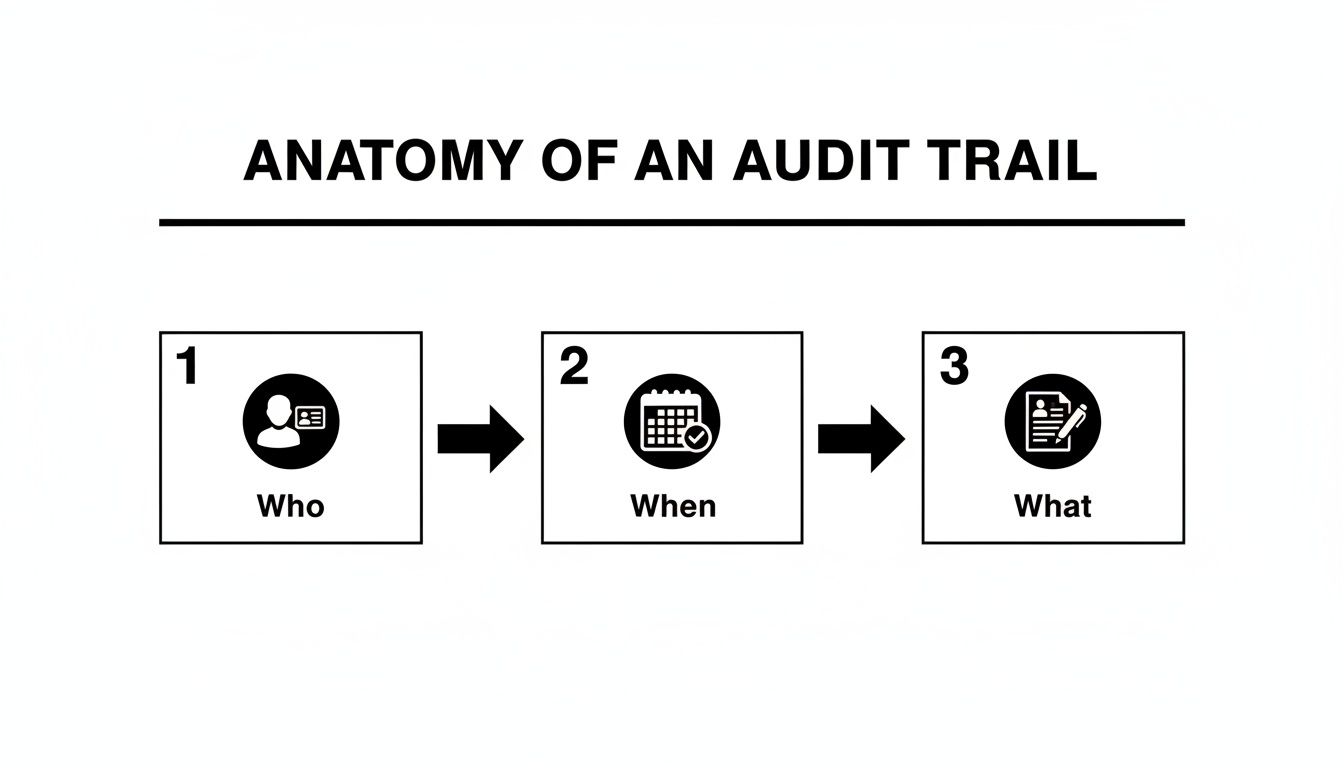
Analyzing these three elements together helps identify patterns that require closer examination, such as changes made at unusual hours or by a user without appropriate permissions.
Common red flags to look for during an ATR include:
- Unusual Timings: Modifications made outside of normal business hours, on weekends, or in a burst of activity immediately preceding a deadline or inspection.
- Excessive Corrections: A single data point or document that has been modified repeatedly, which could suggest process issues or attempts to manipulate data.
- Unauthorized Access: Actions performed by users who should not have permissions to access or approve certain documents.
- Suspicious Deletions: Any record deleted without a clear, documented, and valid reason, which is a significant data integrity concern.
- Mismatched Rationale: A "reason for change" that is vague, illogical, or does not align with the action taken.
Aligning Oversight with Regulatory Expectations
Robust oversight of audit trails in clinical trial documentation is a direct response to regulatory requirements. Sponsors and CROs must conduct systematic, risk-based reviews to detect anomalies and maintain trial quality. Regulations such as the FDA's 2018 Data Integrity guidance and the MHRA's GxP framework explicitly call for periodic reviews in a human-readable format. Furthermore, ICH E6(R2) encourages centralized monitoring, a practice that can be informed by audit trail review. For additional context, see these perspectives on trial audits from experts at The FDA Group.
Documenting the review is as important as performing it. An inspector will not only ask if audit trails are reviewed but will also demand to see the documented evidence of those reviews, including findings and subsequent actions.
A well-defined ATR program provides regulators with evidence of meaningful control over electronic records. It demonstrates that the audit trail is an actively managed component of the quality system, reinforcing the integrity of clinical trial documentation and supporting a state of constant inspection readiness.
How Audit Trails Tell the Story of Your Documents
An audit trail serves as the biography of a clinical trial document, tracing every interaction from its initial draft to the final, regulator-ready version. This unbroken chain of evidence is fundamental to demonstrating that a study was managed with integrity and control.
Connecting the concept of an audit trail to the daily workflows of clinical and regulatory teams is key to understanding its operational value. Each document follows a unique lifecycle of creation, review, and revision. The audit trail's function is to capture this journey, creating a defensible history that reflects how the work was performed.
The Clinical Trial Protocol Journey
The protocol is the foundational document of a study, and its lifecycle involves intense scrutiny and formal, documented amendments. The audit trail acts as the official historian, ensuring every modification is recorded and justified.
A typical protocol amendment would be logged by the audit trail in the following steps:
- Initial Draft Upload: Shows that a specific user (e.g., medical writer) uploaded Version 2.0 at a precise date and time.
- Stakeholder Review: Records when each stakeholder (e.g., biostatistician, clinical operations lead, regulatory affairs) accessed the document to provide comments.
- Comment Resolution: Creates a complete decision-making history, recording each comment, the response, and the user who marked it as resolved.
- Formal Approval and Signature: Captures the exact moment the Sponsor and Principal Investigator applied their electronic signatures, each with a secure, verifiable timestamp.
This detailed history demonstrates that the final protocol is the result of a controlled, collaborative, and compliant process, providing an inspector with the information needed to reconstruct how the final study design was established.
Tracking the Investigator's Brochure
The Investigator's Brochure (IB) is a dynamic document that must be updated with new safety and efficacy data as a trial progresses. For the IB, the audit trail is crucial for demonstrating that investigators and ethics committees were kept informed with the most current information, a fundamental requirement of Good Clinical Practice (GCP).
When a new safety signal emerges, an audit trail would show:
- The exact date and time the new safety information was incorporated.
- The user ID of the pharmacovigilance specialist who made the change and the medical lead who approved it.
- A record confirming that the updated version was distributed to all sites, logging the distribution event itself.
This provides a clear, defensible timeline of how safety information was managed, proving that critical updates were handled promptly and transparently.
An audit trail provides the evidence-based history of a document’s development. For final submissions, this record is essential for proving that the document is fully traceable, from its first draft to its final, locked version.
Documenting the Clinical Study Report
The Clinical Study Report (CSR) consolidates extensive data, analysis, and narrative into a single comprehensive report. Its audit trail is highly complex, as it must track the integration of statistical outputs, cross-functional reviews, and the final narrative lock.
For a CSR, the audit trail provides a clear record of events such as:
- The integration of tables, listings, and figures (TLFs) from the biostatistics team, including the version of the statistical outputs used.
- Every comment from medical, regulatory, and QA reviewers, along with the documented resolution for each.
- The final action of locking the document to prevent further changes after final approval.
This complete log provides proof that the final report is a true and accurate reflection of the study’s conduct and results. It is the essence of document traceability across the clinical trial lifecycle, ensuring every claim in the CSR is supported by a verifiable data trail. This level of detail confirms that the final analysis is complete, accurate, and ready for regulatory submission.
Achieving Inspection Readiness with Robust Audit Trails
Ultimately, the purpose of maintaining meticulous audit trails in clinical trial documentation is to ensure a constant state of inspection readiness. A complete and regularly reviewed audit trail is a primary tool for demonstrating compliance to an inspector from the FDA, EMA, or another health authority. It provides objective, verifiable evidence that established processes were followed.
Inspectors use these trails to reconstruct the trial's documentation history. They can follow the lifecycle of a critical document—from the protocol to the Investigator's Brochure—to verify that every action was authorized, documented, and aligned with SOPs and GCP guidelines. The audit trail serves as a roadmap for confirming a study's integrity.

What Inspectors Look For in an Audit Trail
When an auditor examines an audit trail, they assess the quality of the log to determine if systems and processes are truly under control.
Their checklist often includes:
- Completeness and Integrity: The trail must be unbroken. Any gaps or unexplained deletions raise immediate concerns about data reliability.
- Documented Periodic Reviews: They will expect to see evidence that audit trails have been actively reviewed throughout the study.
- Clear Explanations: Significant changes should be supported by a clear and logical rationale. Vague entries like "updated per request" are insufficient.
- Attributability: Every action must be clearly linked to a unique user, confirming that only authorized personnel accessed or modified critical documents.
An audit trail transforms the abstract concept of 'compliance' into tangible proof. It is more than a system feature; it is a cornerstone of a transparent, quality-focused process that strengthens an organization's position during a regulatory inspection.
A strong audit trail simplifies the process of defending a study's data. This operational discipline is fundamental to ensuring Trial Master File completeness and inspection readiness by providing the objective evidence that a trial was conducted with integrity.
Frequently Asked Questions
These are some of the most common operational questions from clinical trial professionals regarding audit trails.
What Is the Difference Between an Audit Trail and Version History?
While related, these two concepts serve distinct purposes. Version history provides a high-level summary of a document's evolution, marking major milestones like the transition from Version 1.0 to 2.0.
An audit trail, in contrast, offers a granular, forensic-level detail of every interaction with the document. It logs every view, edit, comment, and signature, linking each action to a specific user and timestamp. This unchangeable, detailed log is what regulators require to verify data integrity.
How Often Should an Audit Trail Review Be Performed?
There is no single prescribed frequency; the appropriate interval depends on risk. The guiding principle is to review audit trails periodically throughout the trial, rather than waiting until the end of the study.
A risk-based approach is recommended.
- For high-impact systems and documents (e.g., protocols, informed consent forms, Clinical Study Reports), reviews should be conducted more frequently, such as on a weekly or bi-weekly basis.
- For less critical data, a monthly or quarterly review may be sufficient.
The organization's SOPs should clearly define the rationale for the review frequency, linking it directly to the trial's complexity and the data's criticality.
Are Handwritten Comments on a Draft Part of the Audit Trail?
This question highlights the difference between paper and electronic processes. In a traditional paper-based system, handwritten notes are part of the document's history, but they do not constitute an electronic audit trail. Traceability is achieved through physical documentation and formal review records.
In a compliant electronic system, any comment or annotation made within the platform must be captured by the electronic audit trail. The system must link that comment to a specific user, a timestamp, and its precise location within the document.
In both paper and electronic environments, the objective is the same: to ensure that every change and the rationale behind it are traceable and attributable.