For decades, clinical trial documentation consisted of extensive paper records—binders stored in file rooms, often across different locations. The Trial Master File (TMF) was a physical artifact, assembled and managed through manual processes. Today, this paradigm has shifted.
An electronic Trial Master File (eTMF) system is a specialized software platform designed to manage clinical trial documentation. It serves as a central repository for collecting, managing, and archiving the essential documents required to reconstruct a clinical study, from protocol development to the final clinical study report.
The adoption of eTMF software is driven by the need to ensure that every document is secure, accessible to authorized personnel, and available for regulatory inspection, in alignment with Good Clinical Practice (GCP) guidelines.
What is an Electronic Trial Master File (eTMF)?
An eTMF is the complete collection of documents that allows for the reconstruction of a clinical trial's activities and the evaluation of its conduct and data integrity by internal teams or regulatory inspectors. Electronic Trial Master File software operationalizes this concept, transforming a static archive into a dynamic environment for study management.
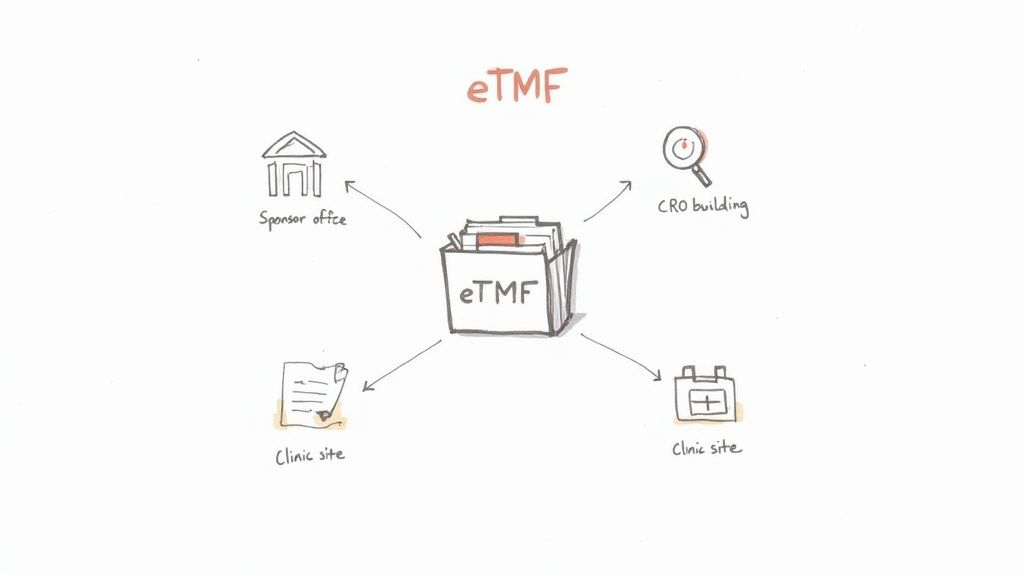
This transition is a response to the increasing complexity of modern clinical trials. As studies become more global and decentralized, a centralized, digital system is an operational necessity. Market data reflects this trend. The global eTMF systems market, recently valued at US$1.21 billion, is projected to reach US$2.49 billion by 2030, reflecting a compound annual growth rate of 12.8%.
The table below outlines the fundamental differences between paper-based and electronic TMF management.
Paper TMF vs Electronic Trial Master File Software
This table provides a comparison of how moving from a paper-based to a digital system affects trial management operations.
| Attribute | Paper TMF | Electronic Trial Master File Software |
|---|---|---|
| Accessibility | Limited to physical location; requires shipping and manual handling. | Secure, 24/7 global access for authorized users from any location. |
| Collaboration | Sequential and slow; difficult for multiple teams (sponsor, CRO, sites) to work concurrently. | Real-time, simultaneous collaboration with version control and defined workflows. |
| Inspection Readiness | Requires a significant, time-consuming effort to prepare; often reveals gaps late in the process. | Continuous inspection readiness; auditors can be granted remote access for review. |
| Oversight | Difficult to monitor completeness and quality in real time; relies on periodic manual checks. | Dashboards and reports provide visibility into TMF health and completeness. |
| Security | Vulnerable to physical damage (fire, flood), loss, and unauthorized access. | Robust security with access controls, audit trails, and validated data centers. |
| Cost | High costs associated with printing, shipping, and long-term physical storage. | Subscription-based model with lower operational costs and no physical storage needs. |
This comparison illustrates a shift from a reactive, archival process to a proactive, operational one.
A Standardized Framework for Compliance
A significant aspect of modern eTMF software is its inherent structure. Most systems are organized around the TMF Reference Model, an industry-standard index that provides a common taxonomy for organizing trial documents. It categorizes all documentation into logical zones, sections, and artifacts.
This standardized blueprint offers several operational advantages:
- Predictable Filing: All team members understand where each document, from the Investigator’s Brochure to a site monitoring visit report, should be filed. This consistency is valuable across multiple studies and teams.
- Built-in Quality Checks: The model serves as a completeness checklist, making it easier to identify missing documents. This allows for early detection of documentation gaps, rather than during a pre-inspection audit.
- Smoother Collaboration: When sponsors, CROs, and sites use the same structure, communication is improved and operational efficiency increases. This reduces ambiguity regarding document identification and location.
By embedding this model, the software supports the correct filing of critical documents, establishing a foundation for regulatory compliance. You can explore this further by learning more about what defines a modern regulatory document management system.
The Power of Real-Time Oversight
A paper TMF is often a historical record, assembled after events occur. An eTMF is a live system designed for active, real-time management, which is key to maintaining a state of constant inspection-readiness.
A well-maintained eTMF provides a contemporaneous record of the trial. It is a living document that demonstrates to regulators that the protocol was followed and that the rights and safety of participants were protected.
This real-time visibility is operationally significant. Study managers can log in and see the status of document collection, track review cycles, and monitor approvals across all sites. This proactive approach allows teams to identify and correct potential compliance issues as they arise, rather than months later during an inspection. It is a critical safeguard for a trial's integrity.
Untangling the eTMF Regulatory Web
eTMF systems are built upon a foundation of global regulations and guidelines. These frameworks are designed to protect patient safety and ensure data integrity. They provide a universal standard for how clinical trial documents must be managed, secured, and stored.
For organizations involved in clinical development—including sponsors, CROs, and research sites—understanding these requirements is essential. They dictate the technical and procedural controls necessary for managing clinical trial documentation throughout its lifecycle.
The Cornerstone: ICH GCP E6(R2)
The International Council for Harmonisation (ICH) Guideline for Good Clinical Practice, specifically ICH E6(R2), is the globally recognized standard for ethical and scientific quality in clinical research.
ICH GCP requires every trial to maintain a Trial Master File containing "essential documents." These are the records that, collectively, permit the reconstruction of the trial and an evaluation of its conduct. While ICH GCP is a guideline, major health authorities like the FDA and EMA have incorporated its principles into their regulations, making them legally binding in their respective jurisdictions.
For an eTMF system, this means it must be able to:
- Securely contain all essential documents as defined by GCP.
- Ensure that these documents remain complete, legible, and unaltered.
- Provide a complete history of each document through version control and audit trails.
The Digital Gatekeeper: FDA 21 CFR Part 11
In the United States, the transition from paper to digital records is governed by the FDA’s 21 CFR Part 11. This regulation defines the criteria under which electronic records and electronic signatures are considered as trustworthy, reliable, and equivalent to paper records.
This rule is a critical consideration for any eTMF used in a trial under FDA jurisdiction. It specifies requirements for system validation, access controls, and the implementation of electronic signatures. For a detailed explanation, you can explore resources on 21 CFR Part 11 compliance.
A key pillar of 21 CFR Part 11 is the requirement for a secure, computer-generated, time-stamped audit trail. This trail must automatically record the date and time of operator entries and actions that create, modify, or delete electronic records.
This audit trail serves as an unchangeable log, providing inspectors with a transparent, chronological history of a document’s lifecycle. It answers the questions of who, what, when, and why for every action, forming an unbroken chain of custody that supports regulatory confidence.
EMA Rules and the "Validated System"
The European Medicines Agency (EMA) has its own detailed guidance that aligns with many of the principles found in FDA regulations. The EMA places significant emphasis on data integrity, audit trails, and the concept of a "validated system." EMA guidance clarifies that the sponsor holds ultimate responsibility for the TMF and the software used to manage it.
This leads to the important topic of system validation. Validation is the documented process of demonstrating that the eTMF software functions as intended for its specific use within an organization's processes and environment. It is the responsibility of the regulated company, not just the software vendor.
This involves performing risk assessments and executing User Acceptance Testing (UAT) to generate formal evidence that the system is fit for its intended purpose. This process documents that critical features such as e-signatures, access controls, and audit trails are functioning correctly to maintain a state of inspection readiness.
What Really Makes eTMF Software Tick? A Look at the Core Features
An electronic trial master file system is a purpose-built environment designed to keep clinical trial documentation organized, secure, and ready for audit. These systems are based on core features that work in concert to support Good Clinical Practice (GCP) and ensure the TMF is a reliable record of the trial.
Let's break down these essential features and their operational importance.

The adoption of eTMFs is a response to operational pressures. As clinical trials become more global and regulations more stringent, the need for robust systems is critical. The market has reportedly grown by USD 679.48 million with a 12% CAGR, largely because features supporting compliance with regulations like 21 CFR Part 11 are now standard. Some organizations have reported a reduction in inspection findings by up to 50% after implementing a dedicated eTMF. If you are interested in the data behind this trend, you can find more information by reading about eTMF systems market analysis.
Document Indexing and Classification
The foundation of an effective eTMF is its structure. Most contemporary systems are built around the TMF Reference Model, a standardized index for organizing all trial-related documents. It provides a universal classification system, from investigator brochures to the final clinical study report.
This standardized approach promotes consistency. When a Clinical Research Associate (CRA) uploads a site monitoring visit report, the system guides them to file it in the correct location—the designated zone, section, and artifact. This eliminates ambiguity and simplifies document retrieval for team members and auditors.
Metadata Management and Searchability
Filing documents is only the first step. The operational utility of electronic trial master file software is enhanced by its use of metadata—data that describes other data. These tags provide context for each document, transforming the TMF from a static repository into a searchable, dynamic database.
Each document is tagged with key information, such as:
- Document Type: e.g., "Protocol Signature Page" or "IRB Approval Letter."
- Study, Country, and Site: The document's organizational and geographical context.
- Milestone Date: e.g., the date a contract was executed or IRB approval was granted.
- Status: e.g., draft, pending review, approved, or superseded.
This level of detail enables powerful queries. For instance, a user can quickly locate all final, approved informed consent forms for sites in a specific country or retrieve all documents related to a single investigator across multiple studies.
The utility of metadata lies in its ability to provide context. It facilitates precise document retrieval, comparable to using a magnet to find a specific needle in a haystack.
Version Control and Document History
Clinical trial documents are dynamic; protocols are amended, investigator brochures are updated, and informed consent forms are revised. A core function of eTMF software is to manage this evolution with complete transparency.
When a new version of a document is uploaded, the previous version is not deleted. The system archives the older version and designates the new one as the current, effective document. This creates a complete, unbroken history. An auditor can reconstruct the state of the trial's documentation at any specific point in time, verifying which protocol version was active on a particular date.
Audit Trails and Access Controls
These features are central to regulatory compliance. To align with regulations like 21 CFR Part 11, every action taken within the eTMF must be recorded in a secure, time-stamped audit trail. This un-editable log captures who uploaded a document, who viewed it, who signed it, and who changed its metadata—and the precise time of each action. It serves as a definitive source of truth and accountability.
Working in conjunction with audit trails is role-based access control (RBAC). This feature ensures that users can only view and perform actions relevant to their roles and responsibilities.
For example:
- A CRA can upload monitoring reports for their assigned sites but cannot approve the final clinical study report.
- A Quality Assurance auditor may have read-only access to all documents for review purposes but cannot edit or delete files.
Together, these features create a secure, controlled environment. They protect data integrity and provide the verifiable evidence that regulatory authorities require, establishing the eTMF as a trustworthy system of record.
Moving Beyond a Digital Filing Cabinet: Advanced Features for Real Oversight
While core features ensure a compliant Trial Master File, advanced functionalities can transform an eTMF from a document repository into a strategic tool for trial management. These features provide enhanced oversight of TMF health, operational efficiency, and inspection readiness.
Modern electronic trial master file software is designed not just to store documents but to actively manage their quality and timeliness. This allows teams to maintain a state of continuous inspection readiness rather than preparing reactively for an audit.
Smart Workflows for Quality Control
The document quality control (QC) process can be a significant bottleneck. Manually checking each document for completeness, accuracy, and correct indexing is time-consuming and prone to human error. Advanced eTMF systems address this with automated QC workflows.
When a document is uploaded, the system can initiate a pre-defined review and approval process:
- Step 1 – Document Ingestion: A CRA uploads a site monitoring report, which the eTMF automatically flags as “Pending QC.”
- Step 2 – Initial Review: The report is routed to a TMF specialist who verifies the metadata and confirms the presence of necessary signatures.
- Step 3 – Final Approval: Following the initial review, the document is sent to the study manager for final approval. A single action can then lock the document as a complete and accurate record.
This type of structured workflow ensures that every document undergoes the same level of review, promoting consistency and quality across the TMF. It also creates a complete, auditable history of the QC process itself.
TMF Health: From Guesswork to Real-Time Data
Reporting and analytics dashboards are among the most powerful tools in an advanced eTMF. They provide a live, data-driven view of the TMF's health, replacing manual spot-checks and spreadsheets with key performance indicators.
A TMF health dashboard functions as an early warning system. It highlights not just what has been filed, but also what is missing, what is late, and where potential compliance risks are accumulating, enabling proactive intervention.
These dashboards track critical metrics such as:
- Completeness: The percentage of expected documents that have been filed, measured against the TMF plan.
- Timeliness: The cycle time for a document to move from creation to final approval in the eTMF.
- Quality: The percentage of documents that pass QC on the first attempt versus those returned for correction.
This clarity allows managers to identify sites that are falling behind, pinpoint process bottlenecks, and allocate resources effectively, thereby maintaining continuous inspection readiness.
Connecting the Dots: Integration with Other Clinical Systems
Clinical trials operate within an ecosystem of technologies. An effective eTMF does not exist in isolation; it integrates with other key platforms to create a unified source of information. This connectivity eliminates information silos and reduces redundant data entry.
For example, integration between an eTMF and a Clinical Trial Management System (CTMS) can allow site visit dates in the CTMS to automatically create placeholders for corresponding monitoring reports in the eTMF. Similarly, integration with an Electronic Data Capture (EDC) system can link study milestones to required documents, ensuring the TMF accurately reflects trial progress.
Archiving That Stands the Test of Time
The responsibility for trial documents extends long after a study closes. Regulatory bodies require data retention for 15 to 25 years, and sometimes longer.
Advanced eTMF software is designed for this purpose, with features for compliant, long-term archiving. This is a formal process of transitioning the TMF from an active system to a secure, read-only archive that ensures data integrity for decades. The system maintains file accessibility and readability, protecting against technological obsolescence and meeting stringent regulatory retention requirements.
How to Select and Implement the Right eTMF Software
Selecting an eTMF system is a significant decision that impacts clinical operations, efficiency, and regulatory compliance. A successful choice involves a thorough evaluation process and a well-defined implementation plan to find a system that meets current needs and can scale for future growth.
The first step is an internal needs assessment. Key stakeholders—from clinical operations, QA, and IT—should collaborate to define the specific problems the system is intended to solve. Identifying primary objectives, whether improving inspection readiness, managing global trials, or streamlining CRO collaboration, provides a foundation for the selection process.
Key Criteria for Evaluating eTMF Software
After defining requirements, organizations can begin comparing vendors. The evaluation should focus on core functionalities and vendor qualifications rather than superfluous features.
Key criteria include:
- Vendor Experience: Look for vendors with a proven track record in the life sciences industry. They should demonstrate a deep understanding of ICH GCP, 21 CFR Part 11, and the operational realities of clinical trial management.
- Scalability: The system must be able to manage the document volume and user load of both small Phase I studies and large, multi-center Phase III programs without performance degradation.
- User Interface (UI) and User Experience (UX): The software must be intuitive for all users, including CRAs, study managers, and site staff. A poor user experience can lead to low adoption and workarounds that compromise TMF integrity.
- Total Cost of Ownership (TCO): The initial purchase price is only part of the total cost. A complete financial assessment should include expenses for implementation, data migration, validation, training, and ongoing support.
Cloud-based systems are prevalent in the market, offering flexibility for decentralized trials and potentially improving work efficiency by 25-35% through secure remote access. This model can simplify collaboration between sponsors, CROs, and sites. You can find more industry analysis on this trend from sources like MarketReportAnalytics.com.
This flowchart illustrates a simplified decision-making process for selecting a system based on organizational needs.

If documentation needs are straightforward, a system with core features may suffice. However, for strategic oversight, advanced platforms with sophisticated dashboards and analytics are more appropriate.
Best Practices for Implementation
A successful eTMF implementation is more dependent on people and processes than on technology alone. A robust plan that prioritizes change management is essential for a smooth transition.
An eTMF rollout is a business transformation initiative, not just an IT project. The goal is to empower users and optimize workflows, which is how the full value of the system is realized.
Critical steps for a structured implementation include:
- Develop a Change Management Plan: Communicate the reasons for the change, the benefits for each user role, and the project timeline. Identify internal champions who can drive adoption and support their colleagues.
- Plan Data Migration: If migrating from paper, a hybrid system, or a legacy eTMF, a detailed plan is required. This involves scanning, indexing, performing QC checks, and ensuring accurate metadata transfer.
- Execute System Validation: The sponsor is responsible for validating the eTMF to demonstrate it is fit for its intended purpose. This includes executing a full validation plan with User Acceptance Testing (UAT) to formally document that the system functions as expected in the production environment.
- Provide Comprehensive Training: Training should be role-based and hands-on, focusing on the specific tasks that CRAs, TMF specialists, and study managers perform in their daily work.
Finally, consider integration with other clinical technologies early in the process. If the objective is a unified clinical ecosystem, discussing eTMF integration capabilities with your CTMS or EDC should be a key part of the selection process.
Common Questions About Electronic Trial Master File Software
As eTMF systems become standard, practical questions often arise during evaluation and implementation. Addressing these questions is key to understanding the system's role, responsibilities, and its application in daily clinical trial operations.
The following are common questions from clinical operations, regulatory, and quality assurance professionals. These topics concern not just technical details, but also strategic decisions for conducting compliant studies.
What Is the Difference Between an eTMF and a General DMS?
The primary difference is specialization. While both an eTMF and a general Document Management System (DMS) manage electronic files, they are designed for different purposes. A general-purpose DMS, such as SharePoint or Google Drive, is a versatile tool for various business functions.
An eTMF, in contrast, is a purpose-built application for the regulated environment of clinical trials. It is designed not just for document storage, but for demonstrating compliance.
Key differences include:
- Structure: An eTMF is typically built around the TMF Reference Model, the industry standard for organizing trial documents. A general DMS lacks this clinical-specific structure.
- Compliance Features: eTMF systems include built-in functionalities to meet regulations like FDA 21 CFR Part 11, such as validated e-signatures and unchangeable audit trails. These features are mission-critical for clinical trials and are not standard in a general DMS.
- Workflows: The system is designed with clinical trial processes in mind, such as document quality control (QC) checks, reviews, and approvals, which are fundamental to maintaining TMF health.
Ultimately, an eTMF is engineered to ensure continuous inspection readiness, a purpose for which a generic DMS is not designed.
Who Is Ultimately Responsible for the TMF?
According to ICH GCP guidelines, the sponsor holds the ultimate responsibility and accountability for the Trial Master File. This responsibility is non-delegable. Even when trial activities are outsourced to a CRO, the sponsor remains accountable for ensuring the TMF is complete, accurate, and inspection-ready.
In practice, TMF maintenance is a collaborative effort. Both the sponsor and the investigator are required to maintain their respective TMFs.
When a sponsor engages a Contract Research Organization (CRO), the CRO typically manages the day-to-day TMF operations. In this model, the eTMF software serves as a shared platform where the sponsor, CRO, and sites contribute documents. The software provides the sponsor with oversight tools—such as dashboards and reports—to monitor TMF health in real time and fulfill their regulatory obligations.
How Does eTMF Software Facilitate Remote Inspections?
An eTMF is a foundational component of a remote inspection. It eliminates the need for inspectors to travel to a physical location to review paper documents. Instead, regulatory authorities can be granted secure, controlled access to the complete, up-to-date TMF from any location.
This provides inspectors with an efficient method for review. They are typically granted secure, read-only access, which allows them to:
- Navigate the TMF Intuitively: Use the system’s search and filter capabilities to locate specific documents or entire sections quickly.
- Verify Document Integrity: Review the full, time-stamped audit trail for any document. This provides a complete history of all actions—who, when, and why—and demonstrates that no unauthorized changes have been made.
- Get a Bird's-Eye View: Use system dashboards and reports to assess the overall health of the TMF, including metrics on completeness, timeliness, and quality.
This controlled, transparent access makes the inspection process more focused and efficient, with minimal disruption to the study team's activities.
What Are the Key Steps for Migrating from Paper to an eTMF?
Transitioning from paper-based records to a fully electronic system is a structured project that requires careful planning to ensure the integrity of historical records and establish the new system as the single source of truth.
The migration process typically includes these phases:
- Planning and Vendor Selection: Define the project scope, identify which documents require migration, establish quality standards, and select the appropriate eTMF software and implementation partner.
- Document Prep and Scanning: Gather and organize all physical documents, scan them into high-quality digital files, and perform an initial quality check to ensure legibility.
- System Configuration and Validation: Work with the vendor to configure the eTMF to align with your TMF structure and workflows. Then, conduct formal system validation, including User Acceptance Testing (UAT), to document that the system operates as intended for its regulated purpose.
- Data Migration and QC: Load the scanned documents and their associated metadata into the validated eTMF. A detailed QC process is then performed within the system to verify that every document is correctly filed and indexed.
- Training and Go-Live: Provide all team members with role-specific training on how to use the new system. Once migration is verified and training is complete, the eTMF becomes the official system of record for the trial.
Article created using Outrank